Why we're wired for stories - and how to tell one
From classrooms to boardrooms, storyteller Mike Payton explains why humans are wired for stories.
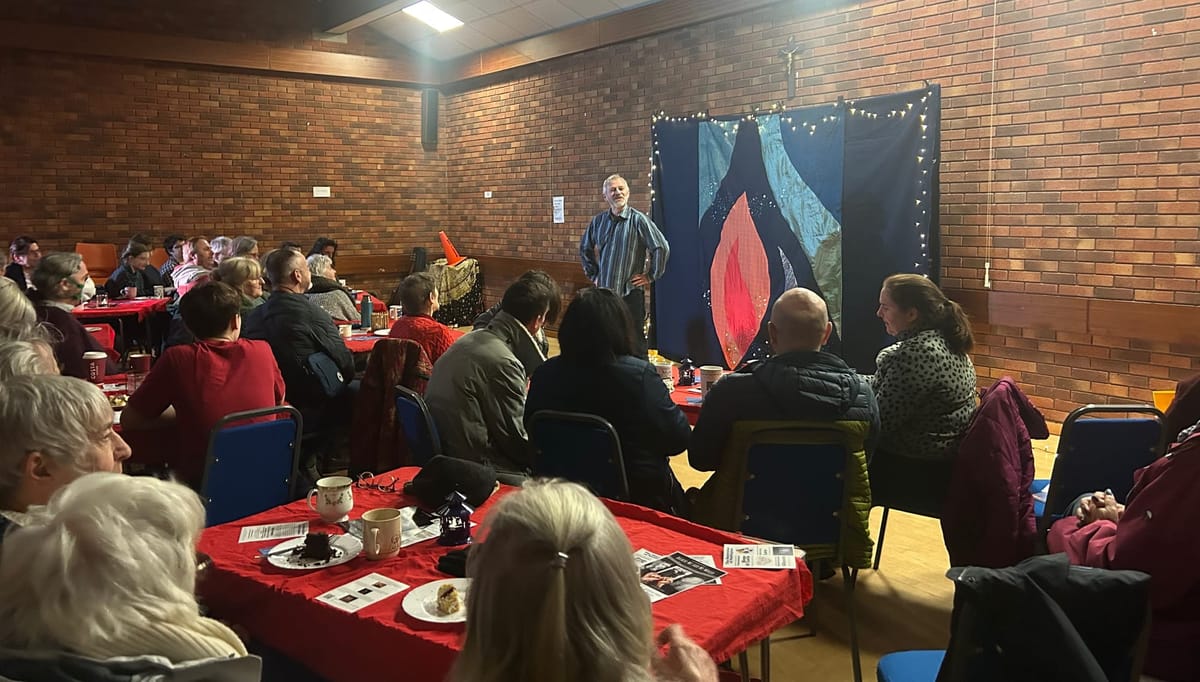
Storytelling may be as old as the wheel, where we can be sure cavemen would sit around and tell each other how Gronk slipped in some woolly mammoth muck, with the little cave children laughing and Gronk blushes in the corner. In more recent history, sitting around and tale-telling was at a very real risk of dying out.
When people began spending more time with their wireless where they knew an interesting story would be delivered to them at a regularly scheduled time slot, they spent much less time in pubs hoping that one of the locals would have an interesting story to tell. The deliberate act of telling stories to each other, not anecdotes but fables and folktales, vanished for a good while.
Traditional storytelling as a performance had a real revival around the 80s, and Mike Payton works today to keep that tradition alive.
One way he does that is through hosting Beeston Tales, as well as performing in schools and corporate environments. Mike was kind enough to answer a few questions about why it's an art form worth keeping around - and learning about.
"It is just a very, very human thing... something about the way we're hardwired makes us crave stories. They make us connect, they make us care."
Mike spent nineteen years as an English teacher, as well as time in South America, and knows first-hand that telling a good story can captivate even the most antsy of children.
"I was teaching this Year Six class in Mexico," Mike told us, "and I didn't really know what to do. We're telling stories but they're a bit old for tales like Hansel and Gretel. How about an old ghost story? I told the one with the hitchhiker and the ghost - you can set it anywhere. They were absolutely mesmerised. And we then used that for the next two classes. We unpicked it, we did some reenactments, we rewrote it."
The National Literacy Trust gives a host of benefits for kids to be reading and being read to: it improves listening skills, encourages empathy, and stimulates an interest in ideas they ordinarily would never think of. This work also includes teaching how to be a storyteller: how to pull together a narrative to capture interest, how to express an idea more clearly, and even improving cadence of speaking.
Mike is full of advice to capture and keep interest: "Where am I injecting a bit of pace here? Where am I going quiet? Where am I thinking a bit more about the elevated language? How much detail is needed to get the audience to visualise it?"
Those skills aren't just useful for children in school though. Anyone whose job involves persuading or explaining could benefit from being able to speak more clearly and coherently.
"Putting information into a coherent narrative is going to make people care."
"We get people from outside of the storytelling world who want to learn how because they're nervous about presenting at work. Presentation skills are really, really important. You have to think about your voice, your eye contact, your pacing. All those little, non-verbal communication skills. But also, what am I saying and can I make it into a story?"
Mike talked about how many problems are stories in disguise: you start with a point of conflict ('this key metric is dropping!'), you adventure around for a solution ('there was a delay!'), and then a resolution and climax ('we got it back on track!').
He learned these skills from his time as a teacher as well as working with Graham Langley on his return to England. Langley is credited as a key part of the storytelling revival in our country. Half a decade abroad and studying under a master teller for years isn't an option to us all though, so how do people get started?
The Beeston Tales founders run workshops infrequently - and you should get in touch if you're interested. There are a few places to start around Nottingham run by others, like Storytellers of Nottingham who are also worth looking into. To put those skills into practice, you can join any number of spoken word events in Nottingham. Poetry, an adjacent art form to storytelling, is quite popular around Nottingham, with multiple events happening most weeks.